Quick Information
Plan your visitIs the Field Museum of Natural History worth visiting?
The visit starts with echoing footsteps, pale stone, and a lobby big enough to hold a Titanosaur overhead. Within minutes, you’re face-to-face with the Tsavo lions, then climbing into galleries where dinosaurs, mummies, and gemstones pull you across eras without making the experience feel like homework.
The museum grew out of Chicago’s 1893 World’s Fair and was built to turn collecting into public knowledge. That original ambition still shapes the place: natural science, human cultures, and deep time sit side by side, so the day feels broader than a standard dinosaur museum.
The payoff is perspective. Few places let you move from a Tyrannosaurus rex to an Egyptian tomb to Indigenous histories of the Americas and leave with a sharper sense of how brief your own timeline is.
Skip it if you want a fast, low-reading attraction or don’t enjoy large museums that reward 3–4 hours on your feet.
What to see at the Field Museum of Natural History?
Stanley Field Hall
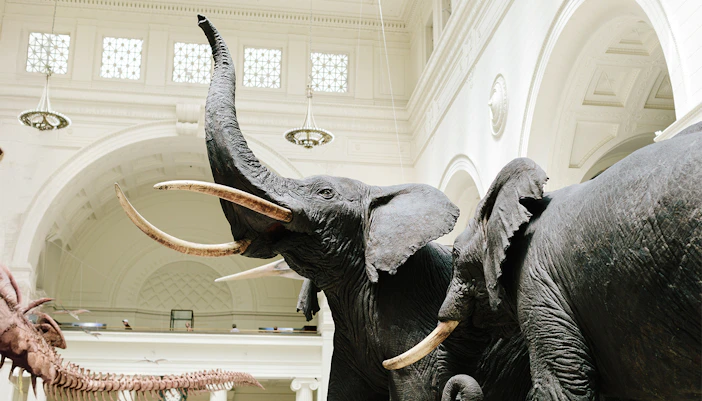
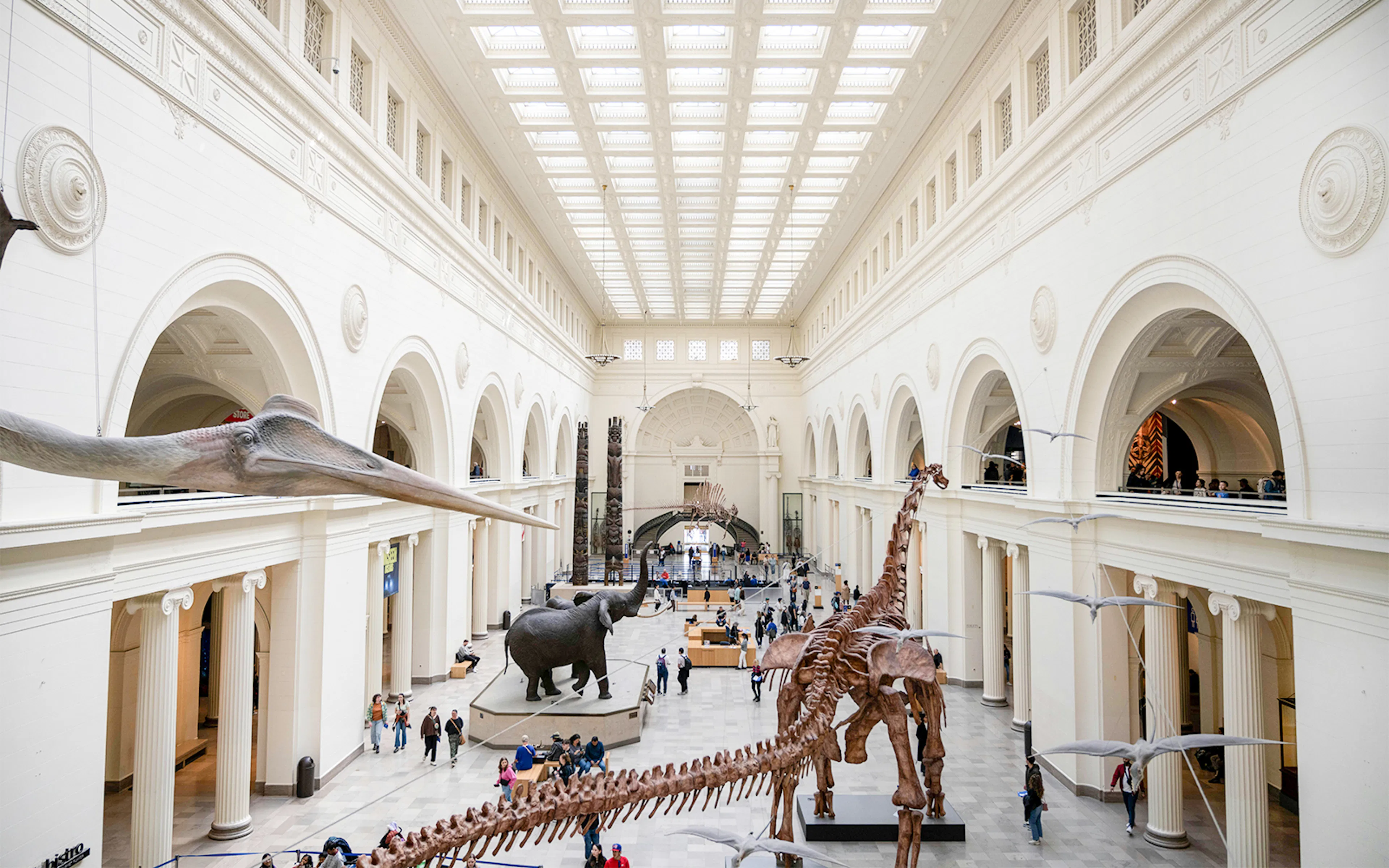
Start in the grand central hall for your first sense of scale. Máximo the Titanosaur hangs overhead, and the famous Tsavo lions anchor one of the museum’s best-known displays. Arrive early if you want cleaner photos.
Griffin Halls of Evolving Planet
This sweeping natural history hall tracks life on Earth across 4.5 billion years. It’s one of the museum’s biggest zones, so budget at least an hour if you like fossils, evolution, and immersive timelines.
SUE the T. rex
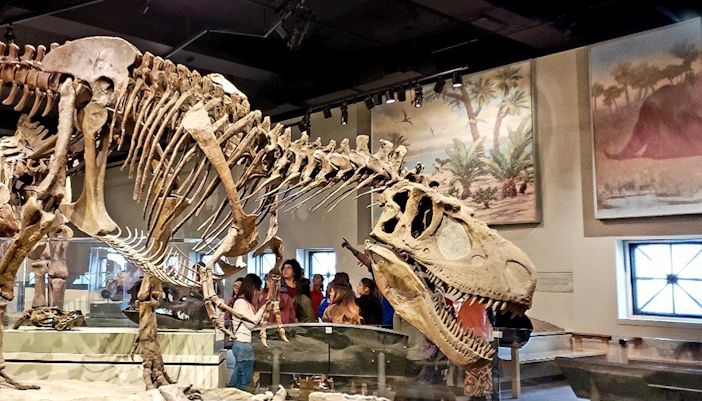
SUE remains the star draw for many first-time visitors. The skeleton is about 90% complete and draws steady crowds through the middle of the day, so see it early or late for more breathing room.
Inside Ancient Egypt
A three-story mastaba tomb replica leads you into one of the museum’s most atmospheric galleries. The human and animal mummies reward a slower visit, and the darker rooms usually feel busiest by late morning.
Robert R. McCormick Halls of the Ancient Americas
This gallery covers 13,000 years of history across the Western Hemisphere. Expect large-scale models, ceremonial objects, and strong context on Indigenous cultures that many visitors end up spending longer with than planned.
Grainger Hall of Gems
More than 600 gemstones and 150 jewelry pieces make this one of the easiest galleries to underestimate. It’s compact, bright, and a good change of pace after heavier history halls. Budget 15–30 minutes.
Underground Adventure
This family favorite shrinks you to insect size and turns soil into a walk-through ecosystem. It’s interactive, playful, and especially busy with kids around midday, so opening hour is the calmest time to go.
How to explore the Field Museum of Natural History?
How much time to spend?
Budget 3–4 hours for a solid first visit, or 90 minutes if you want a highlights-only version. Families often stay longer because exhibits like Underground Adventure slow the pace naturally. If you arrive after 2pm, be selective, the museum closes at 5pm.
Best visit order
Start in Stanley Field Hall for orientation, then head upstairs to SUE and the Griffin Halls of Evolving Planet before those galleries get congested. After that, move to Inside Ancient Egypt, continue to the Ancient Americas halls, then finish with Grainger Hall of Gems and any lighter family-focused stops.
Must-see highlights
Must-see: Stanley Field Hall, SUE, Griffin Halls of Evolving Planet, and Inside Ancient Egypt. Optional: Ancient Americas, Grainger Hall of Gems, and Underground Adventure, which add 60–90 minutes depending on how closely you read and whether you’re visiting with children.
Worth adding nearby
Shedd Aquarium and Adler Planetarium are the most natural add-ons because they sit on the same Museum Campus. Add 2–3 hours for either one. Trying all 3 in a day only works if you treat each as a highlights visit.
Guided or self-paced?
Self-paced works well if you mainly want SUE, Egypt, and a broad museum overview at your own speed. Guided is worth it for visitors who want help connecting paleontology, anthropology, and the building’s major halls into one coherent story. This is a museum where a little structure pays off, but independent visitors do just fine with a map and a clear shortlist.
A brief history of the Field Museum of Natural History
- 1893: The museum’s earliest collections are assembled for the World’s Columbian Exposition in Chicago.
- 1894: It opens as the Columbian Museum of Chicago, preserving fair objects and building a research collection.
- 1905: The institution is renamed for benefactor Marshall Field.
- 1921: The museum moves into its current lakefront building on what is now Museum Campus.
- 20th century: Expeditions and collecting programs rapidly expand its holdings in anthropology, botany, geology, paleontology, and zoology.
- Today: Nearly 40 million specimens and artifacts support exhibitions, research, conservation, and public education.
Architecture of the Field Museum of Natural History
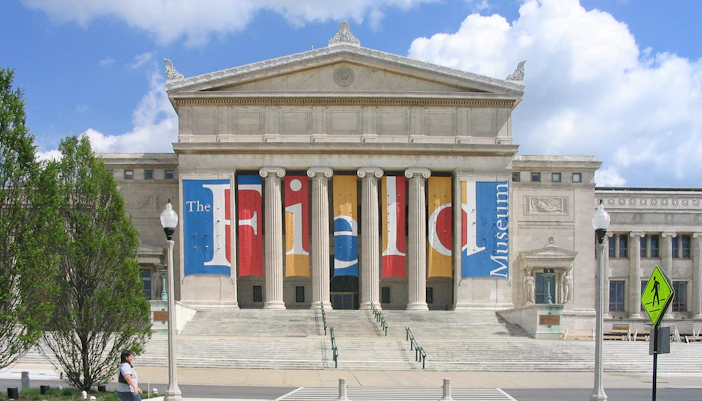
Approaching from the lakefront, the museum feels ceremonial before you even enter. The broad stairway, long limestone facade, and Classical Revival colonnades were designed to make science look civic and permanent, not tucked away in a scholarly corner. Inside, Stanley Field Hall does the same thing on a larger scale: high ceilings, long sightlines, and a central volume that can hold giant animal mounts and dinosaur reconstructions without feeling cramped. The architecture slows you down and makes the collections read as public treasures. Look for the way the building frames movement, from the dramatic entrance sequence to the procession into the major halls, so the visit feels ordered even when the collections span wildly different subjects.
Who built it?
Marshall Field’s donation helped make the museum possible, and its current 1921 home follows a Burnham-influenced vision for Chicago’s monumental lakefront. The point was bigger than storage: to give natural history a grand public stage equal to the city’s major civic institutions.
Why the museum matters to science today
What you see on the public floors is only a fraction of what the museum holds. Behind the exhibits sits a research collection of nearly 40 million specimens and artifacts, used by scientists studying biodiversity, climate history, conservation, archaeology, and human cultures. That matters because the museum is not just interpreting the natural world after the fact; it is still helping document and understand it. For visitors, that gives the displays a different weight: these are not decorative objects, but working collections with ongoing scientific value.
Frequently asked questions about Field Museum of Natural History
No. Máximo the Titanosaur dominates Stanley Field Hall, while SUE is in the Griffin Halls of Evolving Planet. If you only linger in the lobby, you’ll miss the museum’s most famous Tyrannosaurus rex specimen.
Not everything. General admission covers the permanent halls, but 3D films and some temporary special exhibitions require an added ticket or upgrade. Check the day’s lineup before arriving so you do not assume everything is included.
Yes. Both commonly include entry, but you still need to follow each pass’s reservation and redemption rules. On busy days, the important detail is not the pass itself, but whether your visit needs a timed entry window.
Yes. Elevators, wide galleries, and family-friendly circulation make it manageable with young children. The tightest pinch points are usually around SUE and Egypt, but overall it is easier with a stroller than many older museums.
Usually yes for personal use, but flash, tripods, and commercial shooting rules may differ by exhibit. Temporary exhibitions can have stricter policies, so read posted signage instead of assuming the same rules apply everywhere.
Yes, but they are not an unplanned walk-up perk. You typically need to reserve in advance, bring valid Illinois ID, and expect heavier crowds because locals know it is one of the lowest-cost days to visit.
Yes, but only if you stay selective. Museum Campus is easy to walk, yet the museum alone can fill half a day. Pairing works best when you focus on highlights rather than trying to do every major gallery thoroughly.
Choose the Field if you want range, dinosaurs, mummies, gems, and world cultures in one place. Choose Shedd if you want a more focused animal experience. The museum suits visitors who like variety and slower exploration.